Thursday, 17 September 2015

A theory of Adaptation by Linda Hutcheon

According to its dictionary meaning, “to adapt” is to adjust, to alter, to make suitable.

An adaptation is a critical rereading, a critical revisiting of a text. I don’t necessary have to reproduce, to replicate it. Linda Hutchen statest that "[a]daptation is repetition, but repetition without replication". I’m moving from one system to another, from words to images, or sounds. 

It is a fundamental process by means of which literature survives, fundamental process by means of which culture is kept alive.

There is a dialogic connection between two texts as both are in constatn dialogue to each other, the source text and the target text. When we call a work an adaptation, we openly announce its overt relationship to another work.

Concerning fidelity, the author claims that "[a]n adaptation’s double nature does not mean, however, that proximity or fidelity to the adapted text should be the criterion of judgment or the focus of analysis."

Linda Hutcheon’s book on adaptation begins with the statement, “[a]dapting is a bit like redecorating,” which is an apt description of what is happening across the media landscape today.


Friday, 28 August 2015

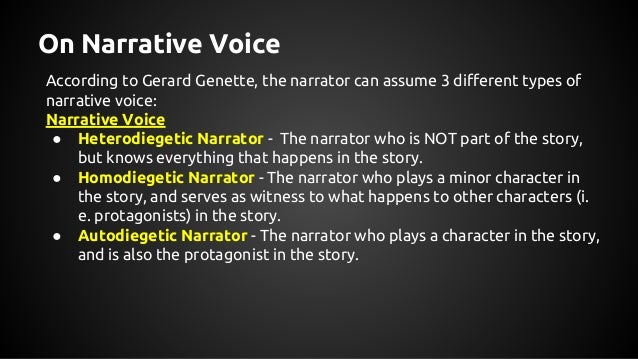
Narrative Voice


Narrative voice: the format (or type of presentational form) through which a story is communicated.

The narrative voice describes how the story is conveyed: for example, by "viewing" a character's thought processes, reading a letter written for someone, retelling a character's experiences, etc. It is intangible, it decides when and how to give us information as well as what to say and what not to say.

In the case of "In Cold Blood" the narrative voice, this invisible concept that organizes the information for us, is going to include dialogues taken from neighbours but also from others like Mrs Clutters' doctor.
It can be ironic, it can anticipate plot, it can also extablish comparisons and contrasts.


Thursday, 20 August 2015

In Cold Blood

In Cold Blood is a non-fiction book first published in 1966, written by American author Truman Capote; it details the 1959 murders of Herbert Clutter, a farmer from Holcomb, Kansas, his wife, and two of their four children.

When Capote learned of the quadruple murder, before the killers were captured, he decided to travel to Kansas and write about the crime. He was accompanied by his childhood friend and fellow author Harper Lee, and together they interviewed local residents and investigators assigned to the case and took thousands of pages of notes. The killers, Richard "Dick" Hickock and Perry Smith, were arrested six weeks after the murders, and Capote ultimately spent six years working on the book.

Some critics consider Capote's work the original non-fiction novel, although other writers had already explored the genre, such as Rodolfo Walsh in Operación Masacre (1957). In Cold Blood examines the complex psychological relationship between two parolees who together commit a mass murder. Capote's book also explores the lives of the victims and the effect of the crime on the community in which they lived. In Cold Blood is regarded by critics as a pioneering work of the true crime genre, though Capote was disappointed that the book failed to win the Pulitzer Prize.